Family Reunions
Because philatelic gems are so rare in the stamp hobby, most of us build our collections upon other, less tangible things that we find satisfying, whether it be completing a study of one intriguing issue or assembling an award-winning thematic exhibit.
Somewhere in those personal collections, all of us have at least one or two of our own gems—items that are priceless to us—but which may sell for virtually nothing at auction or the local stamp store. It has only been about a year since I started to collect covers and to enjoy postal history but, as a result, I have stumbled across some real treasures.
Recently I began to look for covers and postal history from my hometown of Shullsburg, Wisconsin. Perhaps the Wisconsin sesquicentennial fever took hold of me, though I have always been interested in state and local history.
Shullsburg was settled in 1827, making it the fifth oldest city in the state. The first post office in the town of Shullsburg was at Gratiot’s Grove in 1834, which was moved to Shullsburg in 1845. My mother’s ancestors, the Townsends, were among the first to arrive in the vicinity, making them one of the oldest continuous families in Wisconsin. To this day, there are still Townsends living in the city.
The surrounding region was rich in lead and zinc, causing a huge influx of miners and others after it was discovered. The area soon became so populated that the first territorial capital was located eight miles from Shullsburg, in Belmont. Two of my ancestors, my great-great grandfather, Absalom, and his brother, Col. E. C. Townsend, served in the Wisconsin legislature after it was moved to Madison.
In April, the Midwest Stamp Dealers’ Association held a bourse in Madison. As usual I went to see what might be available, but decided to focus more on covers than on off-cover stamps, looking especially for any historically interesting Wisconsin items. While Shullsburg has a long history by Wisconsin standards, it is a small town (approximately 1,200) so surviving covers are not easy to find and often expensive when they are available. At the booth of a dealer from Indiana I found three Shullsburg covers, two of which I felt I could afford.
The
first of the two (Figure 1) has a number of interesting aspects to it, including
the fact that it was canceled on December 25, Christmas Day. Also, Shullsburg is very 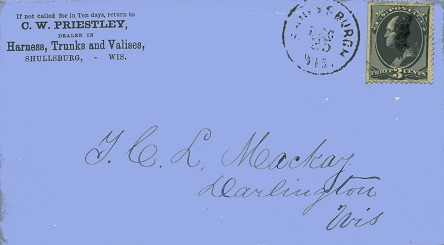 Figure
1
Figure
1
clearly spelled with an “h” on the postmark, the way Pittsburgh is spelled. Nowhere had I ever seen this before, despite having seen and read a great deal of history, maps, advertising pieces and more from the town. If for no other reason the unique added “h” made the cover worth the price to me.
The
Figure 2 cover is from the same businessman, “C. W. Priestley, Manufacturer of
Harness, Bridles, Saddles, etc.,” and also appears to have the “h” in the
postmark. The 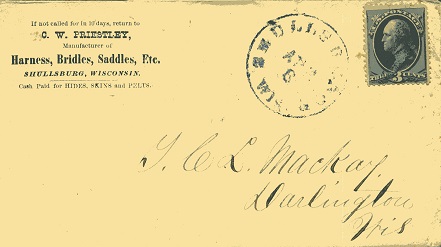 Figure
2
Figure
2
envelopes had been reprinted to include “Cash Paid for HIDES, SKINS, and PELTS,” but the town name is still sans “h” in the return address. The stamp, a 3c green Washington of 1873, Scott 158, is not centered as well as the other, but it is canceled lightly, and the large, blue postmark makes this a nice addition to my fledgling hometown collection.
Moreover, the envelope includes a letter from Mr. Priestley, dated April 7, 1876, which adds to its historical interest. While at the booth I glanced only briefly at the letter, which discusses the pending sale of a house for $600. I bought the two covers and headed home.
Upon
arriving home I took out that day’s purchases to study them further. After a short time, I carefully pulled out
the letter and unfolded it. The front
of the letter is pictured in Figure 3.
Within moments I noticed that on page one of the two-page letter 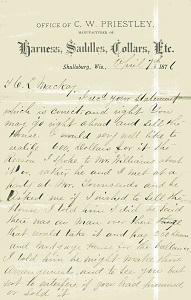 Figure 3
Priestly had written, “ . . . he and I met at a party at Mr. Townsends . . .” While there is no way to tell which Mr. Townsend had hosted the party from the contents of the letter, there is no doubt that it had to be one of my ancestors. All of the Shullsburg Townsends were of the same family. Most likely the host was Col. E. C. Townsend, a Winnebago War veteran, landowner and politician who was known to socialize, though the letter gives no proof. Shullsburg has always been a small town and 122 years had passed since the letter was written, but suddenly I was holding some small piece of family history.
One might think that this was coincidence enough and that more would not come. But in May another postal history coincidence occurred, which was somewhat closer both in years and spirit.
For me, stamp shows are not the only place to find stamps. I tend to find myself stopping at yard sales, auctions, antique malls, thrift stores and other places in order to enjoy the hunt for the elusive undiscovered gem that no one knew was there. In May I found such a gem at the Broadway Antique Mall in Monona, Wisconsin, my current home. While the world’s great philatelists might not waste their time with it, the postcard in Figure 4 has become the one priceless prize in my collection.
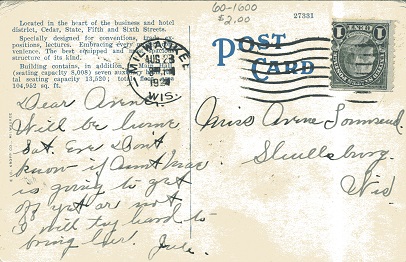 Fig. 4 After
having spent some time searching around I ended up in a far corner of the
antique mall, where I almost failed to notice a card file with postcards in
it. I will often thumb through a group
of cards, looking for any that might happen to be from my hometown.
Fig. 4 After
having spent some time searching around I ended up in a far corner of the
antique mall, where I almost failed to notice a card file with postcards in
it. I will often thumb through a group
of cards, looking for any that might happen to be from my hometown.
On occasion I have found one, but rarely. Very few justify the price antique malls generally ask for postcards. Perhaps a deltiologist would be willing to pay $2 for a unique card, but I’m primarily looking for stamps and postal history. Anything but the most common of stamps on these postcards seems rare, but the hunt is fun.
After looking at countless cards, to the point where my eyes were feeling tired, the word “Shullsburg” jumped out at me from one of them. After seeing that, I noticed that the card had been postmarked in Milwaukee in 1924. Next my eyes moved to the upside-down Franklin coil, Scott 397, affixed to the corner. It was obviously not very well centered, with the perforations going through the picture, but the stamp itself was lightly canceled. As I was looking at it I suddenly realized that the name immediately below the stamp was my mother’s maiden name of Townsend again, and that it was addressed to Miss Avene Townsend, my mother’s sister and my favorite aunt (Figure 5).
 Figure 5
Vene, as we called her, was a saintly woman who never married, but had let her maternal instincts shine by being giving and loving to everyone. Every week, at her place or ours, she was with us for Sunday dinner. Whenever we were sick or injured, she was there to nurse us. When we needed to talk, she was there to listen.
She died 10 years ago, but I can still hear her laughter as she recounted a story about some character or other from Shullsburg. Much of what I know of our family history I learned at her side. With her in my heart I found myself standing in the middle of a store with tears in my eyes, because I was holding a postcard that had traveled a couple hundred miles and almost 75 years, to prick my soul with a flood of laughter and memories.
But there was more to the card than that. I recalled having read an article about the placement of stamps in the early part of this century being a code for various things. I recalled that an upside-down stamp in the upper right corner was a sign of love. But 12 years old was too young for a long distance love affair. Only then did I look at the signature, where I saw the name of my great-aunt, Jule (short for Julia). Vene had lived with her and my favorite great aunt, Mae, in Shullsburg. Some of my earliest memories are of visiting those three incredible women, sitting on their laps and sharing laughter. Laughter is an essential component of our family gatherings.
The final touch to this amazing postcard was the message, which talks about Aunt Mae, who would have been living in Milwaukee with her husband at that time. Years later, after he died, she moved back to Shullsburg, where I grew to love her. The postcard reads: “Dear Avene, Will be home Sat. Eve. Don’t know if Aunt Mae is going to get off yet or not. I will try hard to bring her. Jule.” The only thing missing from this postcard involving the significant women of my childhood is my mother, but this was postmarked about half a year before she was born.
It seems to me that a number of incidental things happened to get this card in my hands, and it won’t be leaving any time soon. $2? No big deal. Happy to pay it. You can give me a thousand such cards for that price. While it may never anchor a prize-winning exhibit, it is a priceless piece, a key that unlocks a time machine in my heart and allows me to go back to some of my earliest memories of love. An inverted Jenny does not have as much meaning as the upside-down Franklin on this card. It is a symbol and a reminder of familial love from my own hometown, a love in which I’ve shared, from a time before my mother was born. That kind of emotional postal history is rare indeed.